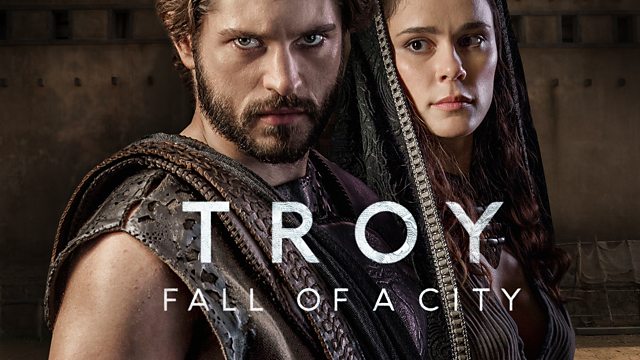
A while back, the BBC released a a brand-new swords and sandals TV series; Troy: Fall of a City. The Iliad, the Homeric story upon which most of the series is based, is one of my favourite stories of all times and so this really was something that I was interested in seeing. This is one of humanities epic sagas up there with Gilgamesh, Journey to the West and Bojack Horseman (yeah I said it, fight me). The Trojan War is a timeless narrative that touches on an incredible depth of issues, ranging from the horrors of war to existential dread, which has kept it relevant to the human existence for millennia. Even more ideally, the Iliad was constructed not as a book, but as a spoken narrative, meaning that it lends itself to TV and movies far more readily than, say, the Lord of the Rings. Much like Tolkien in World War One I went into this series optimistic and rosy cheeked and came out the otherwise broken, depressed and covered in mud. (In fairness that last one is not a result of the series, my cat got out and I had a hell of a struggle getting him back in).
What follows here is my initial thoughts when I first watched it back in the day, edited here and there for clarity. I was tempted to rewrite the entire thing from scratch, but upon rereading I found it amusing to read my slow decline into madness and bitterness. So, for your reading pleasure I present: How Troy Fall of A City Broke an Ancient Historian. Enjoy my suffering.
On with the first episode!
We open with Hecuba giving birth to Paris with a quick shot of a statue that seems to have been inspired by the fairly famous ‘Snake-Goddess’. So, some background real quick. It’s generally thought that if the Trojan War was historical, then it probably happened in the Mycenean period, roughly 1200s BC. The Snake-Goddess statue is technically a Minoan artefact, not a Mycenaean, but there is overlap between them. It’s also not unthinkable that large cities had numerous religions present in them, so the show can get away with this one. It’s great to see the Minoan culture getting bit of love on the silver screen, because they don’t usually get a lot of attention. A solid start!
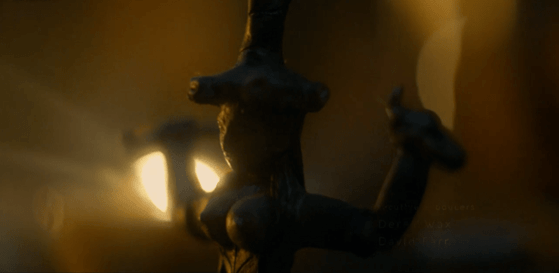

In terms of mythological accuracy though, the scene has got a few errors. Cassandra only gets her ‘gift’ of foresight (along with the curse that no one will ever believe her), after she either refused to have sex with Apollo, or as ‘reward’ for having sex with him (the myths differ). The girl in the show appears far too young, even by Ancient Greek standards, to have been in such a situation.
In myth, rather than Cassandra seeing the future Hecuba dreams of giving birth to a burning torch. This is then interpreted as meaning that her baby, Paris, would cause the downfall of Troy, and that he would need to be killed in order to save the city. Neither Hecuba nor Priam, her husband, could bring themselves to do this resulting in Paris being abandoned instead. I’m not quite sure why the show changed this from Hecuba dreaming to Cassandra seeing the future, but possibly it was to establish Cassandra’s foresight earlier on and give some more weight to her character.
Paris is then shown running around all shepherdy with his adopted father Agelaus. This is all pretty legit, however, there are a couple of side notes. Firstly, just as point of interest rather than an inaccuracy, Agelaus finds Paris abandoned on the hillside and carries him in a bag back to his home. In Greek, the word for ‘bag’ is pera hence the name Paris. In modern terms, Paris is basically called “Handbag”. Which just makes me giggle.
Secondly, Paris is depicted in the show as a boisterous womanizer. This is a pretty modern view of Paris. The idea of him being a flirt like this is not really present in ancient myths, though he is always described as handsome or beautiful. In the Iliad, Homer portrays Paris as a weak fairly cowardly individual, particularly in comparison to his brother Hector. He is not a great fighter, and only survives being slain in a duel with Menelaus when Aphrodite whisks him away (almost literally a deus ex machina). Even Helen tears into him for pretty much being a pansy.
In other myths, however, he is portrayed as being a brave and noble man even being named Alexander (meaning defender of men), as a result of him fighting off some bandits at a young age. He is also renowned in some myths as an honest and just man, hence part of the reason why he is later chosen as adjudicator in the golden apple scenario.
Speaking of, now we come to the apple scene! Without any of the prior set-up this scene comes out of the blue a bit, and it’s a tad confusing why the gods seem to choose this random ass shepherd. But then again gods seem to have a bit of a thing for shepherds in lots of religions…
This is all a bit beside the point though, how do the gods shape up in this show? Well, there’s good and bad. Let’s start with the bad: Zeus should not be a black dude. As with all religions, Greek gods were viewed as looking the same as their mortal worshippers. The Greeks would not have envisioned Zeus as black but looking like themselves. Furthermore, Zeus was almost like a father figure to the Greeks (he fathered a ridiculous number of Greek heroes) and was seen as an embodiment of Greek religion and so should embody these characteristic in his looks. It’s also a tad confusing when one considers that all the Greek gods are related. Hermes, who appears in the same scene, is actually meant to be Zeus’ son…the familial resemblance does not quite seem to be there.


I remember when Gods of Egypt came out and people were, understandably, annoyed that the Egyptian gods of Set, Ra and Horus were portrayed by white guys. That is a poor representation of how Egyptians would have seen their gods, likewise, this is a poor depiction of how Zeus was seen by the Greeks.
On the plus side, the show has chosen to steer clear of the overly CGI monstrosities and kept the gods looking realistic and just fairly, well, normal. This is a nice touch as Greek gods, unlike many other religions, were not really portrayed as perfect all-powerful beings. They were more human that that; they could be jealous, foolish and cruel, just as much as they could be fair, kind and generous. Moreover, the gods weren’t as separate from humans as they are in modern religions. Greek gods always seem to have been popping down from Olympus to mess with mortals, and bumping into some kind of god happens so regularly that it seems almost as banal as seeing a pigeon today. The show seems to embrace this, and the gods are pleasantly human. Nice.
In the show, Paris is offered power by Hera, admiration by Athena and the most beautiful women in the world by Aphrodite. This is all basically accurate, but in myth Paris is actually offered wisdom and military skill by Athena, both things which I’m sure Paris regretted not having when the Trojan War kicks off.
Also, in Euripides at least, Paris is offered not just “the most beautiful in the world” but specifically Helen. This might seem like a fairly minor distinction, but in Euripides’ version, Paris is actively choosing the wife of a king, something which he must have known would have led to trouble. In Euripides’ interpretation, Paris therefore seems much more selfish, foolish and an active participant in the disaster to follow. As I say though, this is just one version of the myth, and the show’s handling of the scene is just as credible.
Paris then meets the princes of Troy on the beach. The show has decided to make them, for the most part, a load of white guys, which is a shame. So far as I know, Homer does not give any description of what Paris, Hector, or other Trojan heroes looked like, aside from generally “beautiful”. However, the historical Troy was a part of, or at least closely linked to, the Hittite Empire which dominated Turkey at the time. This then would suggest that the Trojan princes should have a more Asiatic look to them. In one of the trailers for the series Menelaus is even shown calling the Trojans “Asiatic” and it would have been nice to see this reflected in the cast.
Furthermore, even as early as Herodotus, the Trojan War is often depicted as a confrontation of the Greeks vs those that they perceived as “barbarian”. One of the most interesting things about Homer, however, is how honourable and brave the Trojans nonetheless are in his account, Hector easily rivalling any of the Greek in terms of heroism. There appears to be a subtext in Homer that the “other” is so often not very different from those that do the othering. The failure to cast European actors for the Greeks and more Asian actors for the Trojans means that this nuance is minimalised, if not lost entirely. One would be forgiven, for instance, if they watched the series and assumed that the Trojans and Greeks were effectively the same peoples, as opposed to different cultures.
Next, Paris is recognised by Priam and Hecuba by his birthmark after a scuffle with Hector. In the myths, this scuffle actually gets to the point where Hector and another of his brothers, Deiphobus, attack Paris with swords. The show substitutes this for Paris being almost drowned which, considering how annoying the actor of Paris has been thus far, I found a rather satisfying substitute. I could not find any myth mentioning a birth mark, however. Paris is usually either simply recognised by Priam and Hecuba (who were apparently better at recognising their son than Oedipus’ parents) or is proven to be their son after Agelaus shows them a rattle Paris was given when he was abandoned as a baby. Part of me wonders if the show has included the birth mark almost as an homage to Oedipus whose identity is proven by scars on his ankles. Again, this is only a minor inaccuracy of the show, however.
The show then goes into unknown territory for a bit as Paris struggles to fit in with his family at Troy. I’m not aware of any myth that deals with this, so it’s fairly open to interpretation. What I will say is that Priam’s decision to send Paris as an envoy to Sparta without any of his more respectable brothers is really weird. Paris has shown no princely attitude so far and he has no reputation. To the Spartans, he’s just..osome bloke. The show tries to justify this by saying Paris must “learn on his own”, but it still seems a rather risky idea to send an inexperienced, reckless young man to learn on an important diplomatic mission.
We next zoom over to Sparta where Helen seems to have missed the memo about wearing your best chiton or skirt and has come in fancy dress as a fairly bedraggled looking swan. This is almost certainlytrying to make an allusion to the myth of Helen supposedly being born from an egg as a result of Zeus having sex with her mother Leda while in swan form (I promise I’m not making that up) but it all just comes off as… well, just a bit silly.
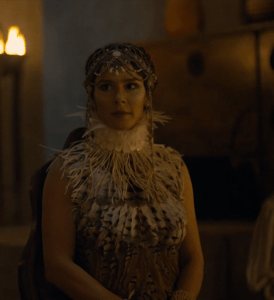
Paris then recounts the story of his childhood and how he was taken from the palace window by wolves. Apparently, these wolves somehow managed to sneak past the huge walls of Troy shown earlier in the show (bet the Greeks would love to know how they did that). Hopefully, this is just the character of Paris not knowing his true origin story, and that he was abandoned on a hillside in classic mythological baby treatment style. I’ll let this one slide for now and assume this will be revealed later in the show.
Menelaus then describes how he met Helen, and here the show plays fast and loose with the myths again. In the show, Helen is supposedly “won” by Agamemnon for Menelaus, after he fought off a hundred other suitors and Menelaus is depicted as almost not being worthy of Helen as a result. To be fair, the myths are also a little bit hazy, but this depiction of Menelaus being unworthy does not appear in any, so far as I know.
In Hesiod, Agamemnon does indeed go to represent Menelaus, however, this isn’t portrayed as a negative thing; Menelaus simply cannot attend the meeting. However, what Hesiod does make clear is that Menelaus is the bookies favourite out of all of Helen’s suitors. He sends the best gifts, has a good relationship with Helen’s brothers, Castor and Pollox, and is strong and warlike. In fact, Odysseus, another of Helen’s suitors, is so sure that Menelaus will be successful that he does not bother to send any gifts. In another version of the myth, the suitors simply draw lots and Menelaus wins. Either way, Menelaus is not portrayed as being unworthy of Helen. Paris’ abduction of Helen is not supposed to be a noble or heroic thing, it is supposed to be a reckless, foolish act, and one that Hector will seriously grill for. This is lost in the show by making it seem as if Menelaus is not worthy of Helen and that he is stifling her. We’ll come back to this again later.
The Oath of Tyndareus, the oath sworn by Helen’s suitors to defend whichever of them marries Helen, is also conspicuously absent from Menelaus’ retelling of the event. This oath is the entire reason that all the Greek kings go to war to get Helen back. Maybe this will appear later in the show (fingers crossed).
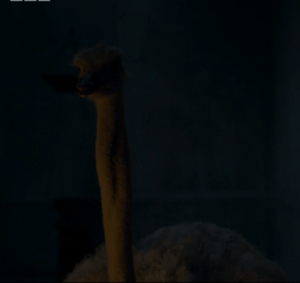
Paris then bumps into Helen outside…oh wait no, that’s an ostrich. Helen’s fashion sense makes it hard to tell the difference. What on earth an ostrich is doing in Bronze Age Sparta, I do not know. Perhaps Paris bought it as a gift? Can’t imagine many Greek kings had an ostrich hanging around. Where Paris got it from, I also do not know but it must have been an absolute menace on that little ship they took from Troy. Shit and feathers everywhere!
Moving on we meet Hermione, Menelaus and Helen’s daughter, who apparently Paris is set to betroth. This has no basis in any myth. In Greek myth, Hermione was actually betrothed first to Orestes, and later to Achilles’ son Neoptolemus. I’m not sure why the show decided to change this. It seems the writers of the show are equally unsure as this little subplot does not seem to develop into anything.
The show quickly name drops Odysseus who apparently has sent gifts all the way from Bactria and Assyria. Fricking Bactria! That’s like modern Afghanistan! With Ithaca being a tiny island of the West coast of Greece, it seems pretty unlikely that Odysseus had access to such exotic gifts from half the world away. Perhaps he knows the same guy that provided Paris with the ostrich…
Not to be outdone in the ‘Stupidest Gift’ category, Hermione then shows Paris a room full or silks that were gifted to Menelaus by an Indian king. Oh dear. Silk is not going to be reaching Greece properly until about 800 years later when Alexander the Great conquers the Persian Empire and so brings an influx of materials from the east into Europe. Even if we ignore that fact, we do not know that the Greeks at this time even knew of India. It seems highly unlikely given that in the 5th century BC India was only vaguely known by Greeks and was supposed to be on the edge of the known world. But according to the show, this Indian king actually wanted to marry Helen, despite her being on the other side of the world! The ridiculousness of this idea is just beyond description.
Fast forward a bit and it appears that Helen has hidden herself in a box in order to go with Paris back to Troy. This, again, has little basis in any myth. In some versions of the myth of Helen of Troy she is raped and abducted by Paris, in others Aphrodite causes her to fall in love with him and they elope. In only one source, Sappho, can I find a version where Helen goes completely of her own free will, and no where can I find a version where she is smuggled away in a box. This has implications on the way the show will handle the story as it almost absolves Paris of any guilt for causing the war. This is an important point in the Iliad; Paris has helped to cause the war because of his own recklessness and Hector is furious that his brother has started a war which results in so many dead and that Paris won’t even fight in, unlike his countrymen. I don’t see how this crucial plot can develop now that Paris isn’t to blame for anything.
Furthermore, this also removes some of the tragedy of Helen. In Homer’s telling of the myth, Helen also seems almost like a prisoner at Troy. She deeply regrets going with Paris and leaving her husband, she is sorry for all the men that die and constantly berates herself calling herself a slut and a bitch. She is utterly ashamed to sleep with Paris and only does so when forced to by Aphrodite, and even then, she chooses to disguise herself so she won’t be seen. She’s a pawn of the gods, exploited and used to further their own aims, and we sympathise with her accordingly. If, instead, she goes willingly to Troy then she is no longer an unwilling participant that is forced into this situation by Paris or the gods. In fact, if the show does include the Oath of Tyndareus, then the war is entirely Helen’s fault as she chooses to go with Paris knowing that this would make the Greek kings would go to war. I think the show must have changed this in order to make Helen and Paris seem almost like Romeo and Juliet with their forbidden love. Whatever the reason, it has little to no basis in myth and takes a lot of the emotional power out of the original story.
Well, that’s the end of episode one! I’m sure I missed a few mistakes here and there, but hopefully I managed to cover the major ones as well as a few of the particularly annoying little ones.
Stay tuned for episode two!
 Historiai