Tag: Macedonia

  • So now we come to the man himself, Alexander the Great. We have looked now at the army that his father, Philip, left him and established that it was well balanced, extremely well disciplined, and highly experienced. However, there have been numerous times throughout history where an excellent army has been led to disaster by a poor leader. Take the destruction of the Roman legions led by Varrus at Teutoborg for example, or the decimation of the Romans at Carrhae under Crassus. These examples show that it would be facile to claim that the Macedonian victory over the Persians was inevitable, with or without Alexander, due to the army alone. A paintbrush and canvas is only as good as the artist who utilises them, and Alexander was a true artist of warfare. This article will aim to focus on the four main areas, which in my opinion, made Alexander one of the greatest generals of all time: his ambition, his ingenuity, his bravery and his ability to read a battle.

    Ambition

    “My boy, you must find a kingdom big enough for your ambitions. Macedonia is too small for you.’” – Philip to Alexander
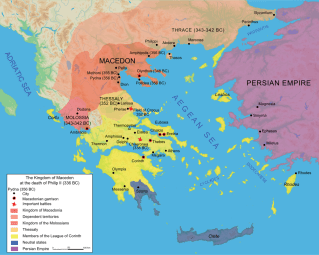
    Macedonian under Philip II
    The Macedonian Empire at the time of Philip II’s death and Alexander’s coronation

    Alexander’s ambition is beyond doubt. This was a man who at just twenty years old attacked the largest empire in the known world. Greek armies had attacked the Persian Empire before, notably under the Spartan king Agesilaus II, but these invasions had been less focused on conquest, and more on liberating Greek cities on the coast and raiding for plunder and so had little lasting effect. Alexander had a bigger prize in mind. He would not be content with just taking a few territories on the Ionian coast, or even the whole of Turkey: Alexander wanted it all. This ambition is what would drive him to take an army from Greece all the way to India; even on his death bed, Alexander is said to have been planning campaigns across North Africa to Carthage and then into Italy.

    Alexander’s ambition meant that his strategy did not have to revolve around simply achieving a few short term objectives, as Agesilaus II’s had, but that he could craft a much grander strategy focusing on the complete conquest of the Persian Empire. This was an aim that all Greeks could unite behind and so Alexander had no fear of losing political support at home. He was also not so short-sighted as to be content with simply defeating the Persians in battles and annexing land. He instead aspired to creating a Hellenic-Persian Empire. Throughout his campaigns, Alexander would found almost twenty cities from Egypt to the Punjab. Instead of destroying the Persian Empire, Alexander almost absorbed it. The bureaucratic system of satraps used by Persian kings was kept, as were many of the traditions. This laid the ground for a multi-cultural Hellenism that would define the near-east for centuries, and could even be seen as a forerunner of the Renaissance.
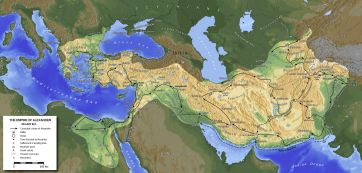
    Macedonian empire under Alexander
    The Macedonian Empire at the time of Alexander’s death. It is thought that this encompassed 35-40% of the world population at the time.

    This personal drive to achieve something extraordinary was something that men could rally around and that his army could take pride in being a part of. Indeed, in his twelve years of campaigning, he suffered just two mutinies, both born more out of a desire to return home as opposed to any lack of confidence in Alexander’s abilities to achieve his objectives. If a general loses the faith of his troops, then the battle is lost before it is even fought. It is clear that Alexander’s ambition inspired his men to constantly support him against huge odds and was the driving force behind the campaign across the known world.

    Ingenuity

    “There is nothing impossible to him who will try” – Alexander

    Throughout his campaign, Alexander would encounter many extremely difficult challenges. However, each time he was able to think of a new innovative solution in order to overcome the obstacle. Perhaps the best example of this would be the Siege of Tyre.
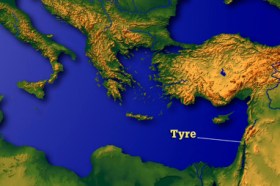
    tyre location
    Tyre’s location. It was a crucial target for Alexander as it had one of the largest harbours in the Levant and so needed to be taken to secure his supply line.

    Tyre is a coastal city in the Levant, and with half the city situated on a small island surrounded by walls, it was known as being nigh impenetrable. This was a crucial target for Alexander to conquer and, with its excellent geographical position and formidable defences, would require all his cunning and innovation.

    Put yourself in Alexander’s sandals for a moment. You stand on the coast and look out towards the island 1,000 metres away, with walls almost 50 metres tall. How do you begin to tackle it? Starving out the opponents is possible, but slow and you are in enemy territory and so would risk allowing your enemy to regroup and attack you from the mainland. Do you build a bridge in order to move ladders up to the city? Possibly, but the Tyrian navy is strong and would be sure to burn any wooden bridge that was built. You have no significant siege weapons to speak of, none at least that would be able to fire a missile so far with enough power to damage the walls. So what do you do?
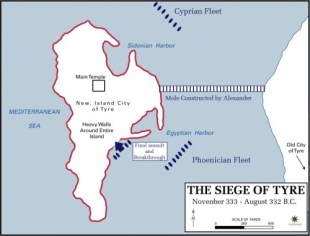
    siege of tyre
    The Siege of Tyre showing Alexander’s mole. Note how the entire island city was walled off, making it an extremely tough nut to crack.

    Alexander, ballsy as ever, decides to bring the mainland to the city and fights the siege on his own terms. He builds a mole, or causeway, using stone taken from the mainland part of the city, approximately 60 metres wide and 1,000 metres long to reach the island. In order to counter the Tyrian archers, 50 metre towers are built at the head of the causeway, complete with ballista and catapults to provide cover. Still Alexander struggles, plagued by the Tyrian navy. Fortunately, from his previous conquests he is able to muster together a few warships from other Phoenician cities, and is gifted more by the King of Cyprus, allowing him to form a blockade of the island. Onto some of these ships, he fits battering rams to attack the walls. Every challenge that the Tyrians throw at him, Alexander finds a solution. There are huge stones under the water to stop ships approaching the wall; Alexander puts cranes on his ships and lifts them out of the water. Tyrian divers cut the anchor ropes of the Macedonian ships; Alexander replaces them with chains. In a coordinated attack from both the causeways and through a breach made by the ships, the city is taken. The siege had lasted just seven months. For comparison, Alexander’s father Philip suffered just two defeats in his career, both sieges, that lasted over a year. This level of innovation and ingeniousness is easily on par with Caesar’s circumvallation of Alesia and shows not just intelligence, but also a level of audacity that is often seen in the best military commanders.

    Tyre is not the only example of Alexander’s innovativeness. As we’ve already seen, Alexander also pioneered the use of heavy shock cavalry and hammer and anvil attacks, tactics that would become staples of western warfare for centuries. Philip and Alexander were also both been innovators of siege weaponry. In fact, they had been some of the first Hellenic kings to successfully take walled cities by force, as opposed to simply starving out the inhabitants. Alexander took this one step further and seems to have been one of the first generals to use artillery on an open battlefield, instead of using them solely as tools during a siege. Whilst these tactics may seem almost banal by today’s standards, at the time they were ground-breaking and it is this kind of creativity that can really take a general from being classed as good or solid, to great.

    Bravery

    “Fortune favours the bold” – Pliny the Elder
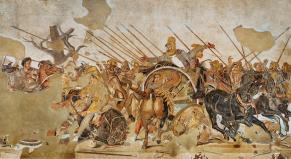
    Darius flees
    Darius (centre in chariot) fleeing Alexander (far left on horseback) at the Battle of Gaugamela as depicted in a mosaic from the House of the Faun in Pompeii

    The importance of bravery for a general at this time should not be underestimated. All kings and rulers were expected to be strong military leaders as well as political leaders, and so it was important that they set an example for their men by fighting alongside them. The importance of a general’s bravery, or lack thereof, is perhaps best illustrated by Alexander’s Persian counterpart, Darius III. At two key battles, Issus and Gaugamela, Darius fled the battlefield triggering a full scale rout of his army on both occasions.

    Alexander was the complete antithesis of this – in every battle that he fought Alexander led from the front. When a crucial charge was needed to break the enemy line Alexander would lead it; during sieges Alexander would be scaling the walls alongside his men, constantly inspiring them by his own example. Throughout his campaigns, he would suffer a plethora of injuries that attest to his bravery and willingness to be in the very thick of the fighting. These included, but are not limited to: a sword thrust to the thigh, a ballista bolt to the shoulder, an arrow to the thigh, an arrow to the shoulder and an arrow to the lung. Alexander put himself through the same risks and dangers that he demanded of his men, and it is clear that this had a profound effect on the moral of his armies. His men consistently faced forces that vastly outnumbered their own and were not wholly routed once, always trusting that Alexander would be able to deliver victory.

    An excellent example of how important Alexander’s personal bravery was to his success was during his Mallian campaign. In one siege when the army was struggling to breakthrough, Alexander scaled the wall and leaped down the other side with just two bodyguard for protection. He killed the Mallian leader but was left effectively stranded and was shot threw the lung. The army, so desperate to either save or avenge their king, launched a final frantic push, cutting their way to Alexander and winning the battle. This is an instance where Alexander’s courageousness directly led to the army’s victory, however, in almost every battle Alexander was constantly situated at the critical point. Whilst Darius is a prime example of the disastrous effect that a general fleeing can have on an army, Alexander is a prime example of how a general’s personal bravery can inspire an army and keep their morale high.

    Ability to read a battle

    “I do not steal victory”- Alexander

    The Ancient World is full of excellent generals, Hannibal, Scipio Africanus, Casear and Pompey to name just a few, but in terms of the ability to read a battlefield, Alexander would, in my opinion, be the best. Indeed, Hannibal, the ‘father of strategy’ when asked who he considered the greatest commander named Alexander before himself.
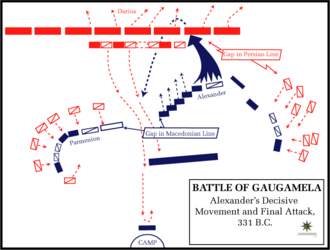
    gaugamela charge
    The moment of Alexander’s charge at the Battle of Gaugamela. Note the hole created by Alexander’s initial feint on the right flank, as well as the holding action being fought on the left. Had this charge been too late or too early, the battle certainly would have been lost.

    Alexander was a fine strategist, however, as a battlefield tactician he was in his element. Alexander’s favoured tactic was to use his phalanx to pin and hold the enemy line in place with his left flank fighting a defensive action, whilst he would feint an outflanking manoeuvre with his Companions on the right, drawing the enemy cavalry away from the flank of their infantry before driving into the resulting hole, and following up with hammer and anvil attacks on the backs of the engaged enemy infantry. This is a very risky strategy. If the crucial Companion charge happens too early, then the hole in the enemy line would not be large enough and could result in the Companions, and Alexander, simply being surrounded and cut to shreds. Too late, and Alexander risked his armies left flank being overrun and his army encircled. Alexander’s timing of this charge was impeccable. Both at the battles of Issus and Gaugamela, it is this kind of charge, directly at the Persian king Darius’ position that results in Darius fleeing the battle, and the Persian defeat. This is what one means when they say that one has the ability to ‘read a battlefield’; it is being able to judge where the enemy is weak, where a charge needs to be focused, and, most importantly, getting the timing right.

    The greatest testimony to Alexander’s tactical ability is the fact that he fought approximately 20 major battles or sieges and was victorious every time. Even his father Philip, excellent general though he was, was defeated twice. Out of the 10 main battles Alexander fought, 4 were opposed river crossings and 2 were in defended narrow mountain passes. These are very difficult terrains for an attacking army, especially one relying on heavy cavalry and phalanxes, both of which excel in open terrain. Alexander’s success in such circumstances is again testimony to his extraordinary tactical ability.

    Conclusion

    “A tomb now suffices him for whom the world was not enough” – Alexander’s tombstone

    It has become almost clichéd to say that Alexander was a great general, however, it is not a cliché without any evidence, nor one that becomes any less true upon repetition. Alexander was gifted the greatest military machine of its time in the form of the Macedonian army. However, it was not an invincible force; Philip had been defeated whilst in command of the force and future kingdoms that used the same army composition would not be able to replicate Alexander’s achievements.

    Alexander was one of these rare figures in history who is truly unique in his time. Philip could not have done what Alexander did, nor could any of Alexander’s lieutenants. The Macedonian Empire and the success of the army was built by Alexander himself. The clearest evidence for this is that just one year after Alexander’s death, his empire would fracture into several smaller warring kingdoms led by his lieutenants. Without Alexander’s personal leadership, without his ambition, without his extraordinary military mind, these Hellenic kingdoms would never again reach the astounding heights they had under Alexander the Great.
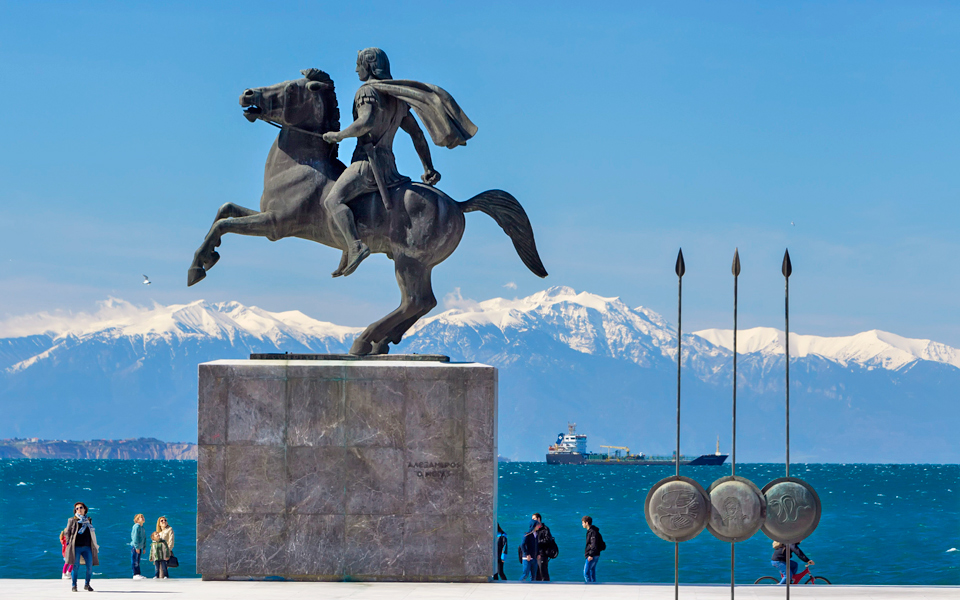
  • Alexander the Great has gone down in history as one of the best generals ever to have lived. After fighting his first battle at just 16 years old in 340BC, Alexander would campaign almost non-stop until his death in 323BC at 32 years old. Throughout this time, he would fight a number of enemies, from Greeks, to Scythians, to Persians, across a variety of battlefields, including open plains, dangerous river crossings and complex sieges. Despite this assortment of enemies and battlefields, as well as often being outnumbered as much as 2:1, he would remain undefeated in his lifetime, solidifying his place as one of the most formidable generals in history.

    The army that Alexander took from Macedonia across the world to India was by far the most powerful army of its time. Its professionalism, flexibility and effectiveness had never before been seen and would not be seen again until almost 400 years later with the Roman legions. Whilst Alexander’s use of this army was by all means incredible, the true genius behind the army’s formation and composition was Alexander’s father, Philip II.

    Philip was a formidable commander in his own right, but his strengths shone more in his military innovations, taking Macedonia from a somewhat weak and backwater kingdom to the strongest power in Greece. This being the case, for us to understand what made Alexander so successful, it is crucial that we understand the army that he inherited from his father, Philip.

    Phalangites

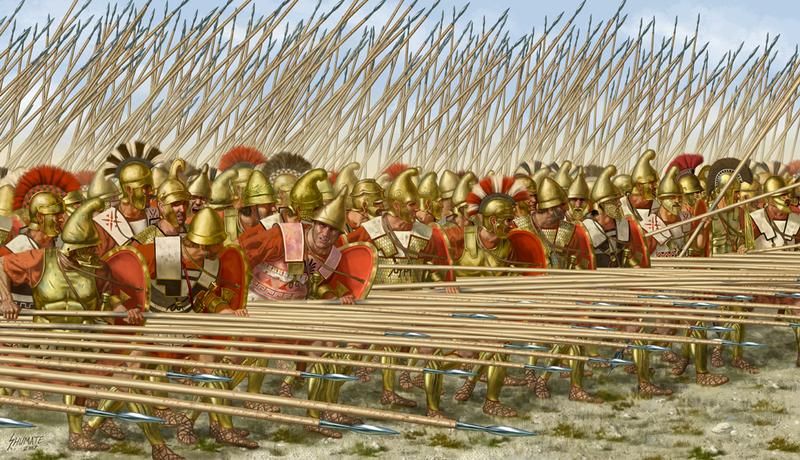
    The backbone of all Hellenistic* armies of the time was the phalanx. This formation was made by hoplites (hop-lights), Greek city-state soldiers with a spear and large shield, forming a wall that was almost unassailable from the front. This formation had served Greek had served Greek armies well for for hundreds of year, being the source of the Greek successes in the Persian Wars. Philip took this tried and tested formation and introduced his own reforms, developing an even more potent force.

    Greek phalanx
    A Greek hoplite phalanx, note the short spear and large shield.

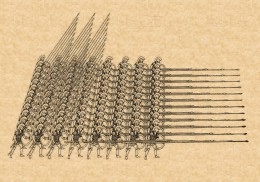
    Philip spent time as a “hostage” (more like a squire, think Theon of Game of Thrones for the Starks) in Thebes where he would spend time learning from the two great Theban generals, Pelopidas (pel-op-ee-das) and Epaminondas (i-pam-in-on-dis)*. These two men had themselves built Thebes from a second rate power into a force powerful enough to crush the legendary Spartan soldiers in open combat through their military innovations. The most significant change they had made was to have a much deeper phalanx than was usual, thus presenting a narrower front, but with more spear points able to engage the enemy in front. Philip, recognising the power of this, mimicked this with his own phalanx; the standard Greek phalanx seems to have been 8 men deep, whilst Philip’s Macedonian phalanx seems to have been more like 16 men deep.

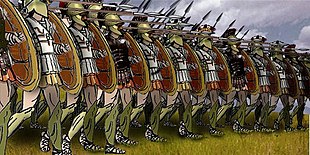
    Macedonian Phalanx
    Macedonian phalangites in phalanx formation, note the longer sarissa pikes and the deep formation

    To maximise on this new formation, Philip also introduced a new way of arming his phalanx, inspired by the innovations of Iphicrates (If-i-crart-ees) of Athens. Iphicrates had introduced a longer spear, along with a smaller shield, to the Athenian hoplites. Philip built on this idea and issued his troops with a 6m long pike, a sarissa (sir-iss-a), also with a smaller shield*. Most other hoplites had used a spear roughly 2-3 metres long, a dory, in one hand, and a large hoplon shield in the other hand (hence the name hoplite). However, the newly armed Macedonian soldiers, known as phalangites (fal-an-jites), wielded their extra-long pike with both hands, while their smaller shield was slung over the forearm of one arm. This crucial innovation, paired with the deeper formation, gave the Macedonian phalanx much more reach than the regular Greek phalanx. It must have been a terrifying prospect for an attacking foe; faced with a wall of spears, he would have had to try battle his way through 6 meters worth of spear points, before even being in striking range of a phalangite. With this in mind, it is easy to see how devastatingly effective these men would have been.

    On top of their better equipment, phalangites were also given much better training than their hoplite counterparts. For the most part, Greek hoplites were citizens called up to fight on behalf of their city-state without too much training. There were some exceptions to this, the Theban Sacred Band and Spartans being notable examples, but on the whole the strength of the Greek phalanx lied in its formation. It was not a hard formation to master, each man simply had to hold his place in the line, shield covering his left side as well as his neighbours right, and thrust with the spear. The effectiveness of this simple formation of citizen soldiers should not be underestimated, Persia had been left licking its wounds multiple times after confronting it. However the lack of training and discipline in the troops can be seen in the fact that Greek phalanxes tended to drift to the right as each man sought to take more cover behind his neighbours shield. These hoplites were not expected to carry out complex drills or changes in formation, but simply to act as a wall.

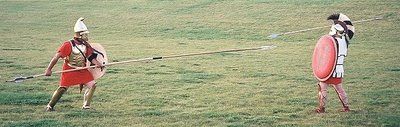
    hoplite v phalngite
    A Macedonian phalangite (left) compared to a Greek hoplite (right)

    Philip, on the other hand, created a professional army. Unlike the hoplites, the phalangites were not farmers who were called up to service only when needed and required to supply their own equipment; instead they were full time soldiers who were given standardised equipment by the state and given proper training. They were able to perform complex manoeuvres and carry out forced marches giving the Macedonian infantry a level of professionalism almost unheard of in the Greek world. Indeed, in one of Alexander’s confrontations against the Illyrians (the peoples roughly between modern Albania and Croatia), the phalangites drilled before battle, executing complex formation changes and manoeuvres in such a disciplined manner that many Illyrians simply decided to call it a day and fled.

    These phalangites were the backbone on the Macedonian army upon which the rest of the army would be built. In battle they acted as the main line providing a solid platform around which Alexander would construct his tactics. Their professionalism and ability to engage and hold a much larger enemy force would be crucial in Alexander’s campaigns, though the credit for their creation and effectiveness must be given largely to Philip.

    Hypaspists

    While the phalangites were deadly from the front, their phalanx formation relied on it maintaining its structure and so was slow, unwieldy and extremely vulnerable from the flanks and rear. To counter this, Philip introduced an elite heavy infantry unit into the Macedonian army to protect the phalanx, the hypaspists (hip-as-pissts).

    hypaspists
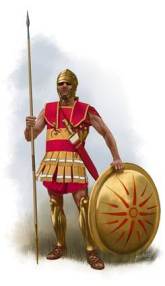
    A hypaspists, note the comparison to the hoplite above with the large shield, and shorter spear than the phalangite.

    Picked from the best of the phalangites, these soldiers were armed more like the traditional Greek hoplite with a larger shield and shorter spear, allowing them more flexibility than the sarissa armed phalangites. Furthermore, as they did not rely on the phalanx formation, they could react more quickly to any outflanking manoeuvres and move rapidly to support the cavalry on the wings if need be. The hypaspists were stationed on the right flank of the phalanx, a traditional place of honour in Hellenic armies. Indeed, Alexander himself would take up position on the right with his Companion cavalry which would be used to strike the main offensive blows. We can see why, therefore, it was important that the hypaspists be more flexible and highly trained. Once the Companions advanced, the phalanx’s right flank would be exposed were it not for the hypaspists. Alternatively, if the Companions needed infantry support, they could rapidly advance to provide assistance.

    As a more elite unit, these troops acted also as the foot bodyguard of Philip and Alexander and were picked for dangerous special missions, such as scaling cliff faces or moving quickly across a river. In Alexander’s campaigns, they played a highly prominent role during sieges where their more flexible armament, greater skill and experience gave them more utility than the phalangites.  It seems that they were almost like the Green Berets of the Macedonian army; elite and highly trained, but in large enough numbers, approximately 3000, to be used as a force individually. The hypaspists were an essential introduction to the Macedonian army by Philip as it helped to negate the phalanx’s key weaknesses; its vulnerable flanks and poor manoeuvrability. Their inclusion in the army was vital as it gave Alexander more tactical options than his phalangites did as well as being able to provide the security Alexander needed to be able to be extremely aggressive with his Companions, which would prove to be crucial in many of his battles.

    Light Infantry

    peltast
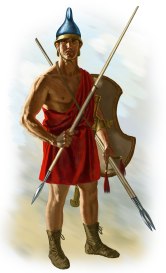
    A peltast, equipped in much the same way as the Thracians and Agrianians

    The light infantry, psiloi (sil-oi) of the Macedonian army has three units of note: the Agrianian (Ag-ree-ain-ian) Peltasts (pelt-asst), the Thracian (Thray-see-un) Peltasts and the Cretan Archers. The Agrianian Peltasts seem to have been an elite unit within the light infantry, also being stationed on the far right, whilst the Thracians fulfilled a similar role, but on the left. Both of these peltasts were skirmishers, wearing little armour and being armed with javelins or slings. The Agrianians seem to have had a more offensive role often being used in conjunction with the hypaspists, providing fast infantry support for the cavalry and harassing any potentially outflanking foes, whilst the Thracians had a similar but more defensive role, protecting the left flank of the phalanx. These two units were also crucial to the army as, alongside the hypaspists, their lighter armour and looser formation meant they could move rapidly in more difficult terrain than the  phalanx could.

    Archers were fairly rare in Greek armies, however, the Cretans had a reputation of being particularly deadly, and so were often hired as mercenaries by Philip and Alexander to provide some range to the army. These archers would likely have been deployed in front of the main force at the start of the battle, before withdrawing behind the main line as needed. Lastly, in the rear of the Macedonian army, were the Greek allied infantry. These would have been traditional Greek hoplites from allied Greek city-states whose role was to protect the rear of the phalanx and the baggage train at the back of the army.

    Summary

    So overall, it should clear to see how crucial Philip’s infantry innovations were in building a formidable and flexible army. Most other Greek armies relied on the phalanx alone being the winning force in the battle. The Macedonian infantry however, was a true example of combined arms tactics, each part complimenting the other: as the phalangites pikes could pin down and engage the enemy infantry, they could do so safe in the knowledge that the peltasts and hypaspists would guard their flanks; if the cavalry advanced on the right flank, the hypaspists could either rush to support them, or remain to guard the flank in their place; where the terrain proved to difficult for the phalanx, the hypaspists and light infantry could be used instead. It was a truly devastating force, effective in both open battlefields and in sieges.

    Whilst it would be silly to not recognise Alexander’s excellent use of this infantry, it is important to remember that the mastermind behind their creation was Philip and so he must also be credited with their success. In this powerful infantry body, Philip had provided Alexander with an anvil. However, Macedonia’s true power lied in its devastating hammer; the cavalry.


    *A general term for all Greek nations/city-states, comparable to words like Nordic or Germanic.

    *The ‘I’ here should sound like the ‘I’ in ‘it’ rather than rhyming with eye.

    *Same as above, once you get your ear in, pronouncing the names is not as hard as it initially seems!

    *They were also issued a sword, however, this was much more of a backup weapon and, so long as the phalanx remained intact, would rarely be used.