Tag: Philip of Macedon

  • The Macedonian cavalry is perhaps the most famous aspect of Alexander’s army. They were a force unlike anything seen before and were Alexander’s most valuable battlefield asset. Once again though, despite Alexander being a masterful tactician, the creation of much of the Macedonian cavalry was thanks largely to Philip.

    It is hard to say how Macedonian cavalry functioned before Philip’s reign, however, what is obvious is that it underwent serious reformation under Philip, just as the infantry had. His innovations would develop the Macedonian Cavalry from an effective force, into the very best in the ancient world. Thanks to Philips innovations and Alexander’s tactics they would become the deciding force in many of Alexander’s battles. This is an important note to understand; Philip and Alexander seem to be the first two Hellenistic generals who used heavy cavalry as a dedicated battlefield force alongside the infantry. They were not being used as a mere supplement to the infantry, but as an integral part of the army, making up almost a sixth of Alexander’s army. It was a revolutionary idea, and one of the very first examples of true combined arms tactics that would be mimicked for centuries to come.
    greek cav
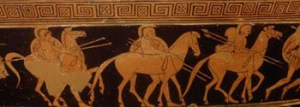
    Greek city-state cavalry. Judging by the helmets and armour, they are perhaps hippeis. Note that they all carry two javelins however; clearly these soldiers are made to skirmish not to charge.

    Comparatively, cavalry in the Greek city-states, or poleis (pol-ey-us), played second fiddle to the hoplite phalanx. They were mostly lightly armoured horsemen and used javelins, mainly acting as scouts or as a screening force. There were a few exceptions to this in city-states, such as the hippes, who were more akin to medieval knights, i.e. wealthy citizens wearing heavier armour, however, even these were used in such low numbers that they should not be counted as a definitive battlefield force. A notable example would be the Spartans who would not create a dedicated cavalry force until 404BC, just 50 years before Alexander’s birth! However, just as the Greek city-states, had gained renown for their hoplite heavy infantry, their neighbouring kingdoms, Macedonia and Thessaly, were famous for their horsemen, often being hired by the city-states as mercenaries, showing how highly regarded they were.

    Companions
    Companion cavalry
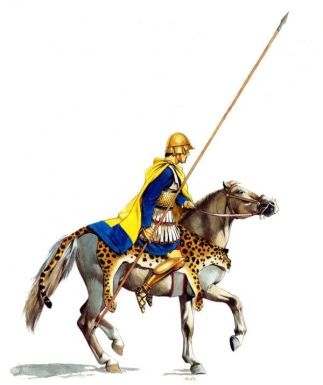
    A depiction of a Companion, armed much in the same way as the Thessalians were after Philip’s reforms. Note the double tipped xyston; if the lance broke during battle, it could be easily reversed to use the other end.

    The most famous of the Macedonian Cavalry was of course, the Companions or hetairoi (het-eye-roy). These soldiers were heavily armoured and armed with a double tipped 3-4 meter long spear, called a xyston. This seems to have been introduced by Philip himself and developed the Companions into the first true shock cavalry force in history. These soldiers were not used simply to harass enemies or pursue fleeing foes as cavalry had previously been used, but as an iron first capable of devastating mass cavalry charges, something unheard of beforehand. To make this force even more potent, Philip also adapted the wedge formation from the Thessalians. This allowed for quicker manoeuvrability, as the leader was always out in front and so easily followed, whilst its shape made it ideal for punching through and enlarging gaps in the opposing formations. As a chisel could be hammered into a crack, so could the Companions smash the weak point in an enemy line. A true crack cavalry unit. (sorry)

    The Companions held the position of honour on the right flank of Macedonian armies and would also act as the mounted Royal Bodyguard. During Alexander’s campaigns, they were often led by Alexander himself, and contained many of Alexander’s closest and most gifted friends and lieutenants. Due to their heavy armour and excellent training, in sieges they could dismount and fight as heavy infantry, proving to be as deadly on foot as on horseback. Thanks to Philip’s reformations, they became the true powerhouse of the Macedonian army, and many of Alexanders victories can be attributed to a devastating charge of Companions at the crucial moment in the battle.

    Thessalian Cavalry 

    While the Companions took place of honour on the right flank and acted as the aggressive arm of the army, the left flank was held and defended by the previously mentioned Thessalian Cavalry. Philip had held the position of Archon of the Thessalian League, effectively the head of all Thessalian peoples, and so was easily able to assimilate these famous horsemen into his army.
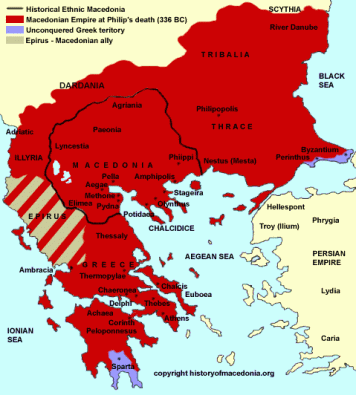
    Greece map
    A map showing Greece at Philip’s death. The Greek city-states have largely been conquered, aside from Sparta, but key states are shown. Not Thessaly’s location, just south of Macedon, from where Philip would assimilate cavalry.

    Positioned on the left, their role was less offensive than the Companions but no less crucial. Armed in a similar style to the Companions, their task was to protect the flank of the phalanx and prevent encirclement; a difficult role and one that speaks to their high regard and trust. They would fight extremely tough battles in Alexander’s campaigns, both at Issus and Gaugamela notably, where they were often outnumbered and where their failure could have resulted in the encircling of the whole army and so disaster. The reliability of this force allowed Alexander to focus on the right flank where he could strike the definitive blow with his Companions, safe in the knowledge that the Thessalians would hold the other flank.

    Prodromoi

    The Macedonian cavalry was rounded off by the light cavalry, the prodromoi (prod-rom-oi). These soldiers were armed much more like the majority of Greek cavalry mentioned above with light armour and javelins. They fulfilled the more traditional cavalry roles, scouting and screening.Though not as glamorous nor prestigious a role as the Companions and Thessalians, their role was nonetheless important in scouting and gathering important information prior to a battle, something Alexander put a lot of emphasis on. However, as Alexander’s campaign continued, he would incorporate native light cavalry into his army such as eastern horse archers, and these natives proved to be better at scouting. It seems that Alexander then armed the prodromoi with a sarissa and that they too adopted more of a shock cavalry role.

    Summary

    The use of heavy cavalry as a shock force was revolutionary and is the source of much of the armies success. Alexander would personally oversee the Companions in almost all their battles, a testament to how valuable they were, leading charges at the weak points in the enemy line and turning the battle. Philip had completely reinvented how battles would now be fought, particularly in the Hellenistic world. No longer were battles decided by shoving matches between massed infantry bodies, but by the careful timing and execution of a cavalry charge into the back of the engaged foes; the classic hammer and anvil. This was a tactic which Alexander mastered and would become a staple of a generals recipe book, from Hannibal to Napoleon to everyone playing Total War.

    Overall, what we see at the end of Philip’s reign is a truly devastating army. Philip had learned from neighbouring states, adopting and adapting tactics as he saw fit to develop a professional, well drilled and balanced army. The combination of heavy infantry, skirmishers and heavy cavalry gave the Macedonian army a level of flexibility previously unheard of. Philip had taken a nation that was considered a bystander to the major Greek players, and formed a force powerful enough to go toe to toe against the very best that the Greeks and Persians had to offer. Upon his death, Alexander would inherit the most professional and deadly army in the ancient world. Thanks to his father, Alexander would not have to waste anytime building his own army, but could use his Philip’s force as soon as he took the throne to begin his conquest of the known world. Whilst it might seem, therefore, that the majority of Alexander’s success be attributed to Philip, it is important that we understand that any army is only ever as strong as it’s general. As Alexander himself said:

    “It is better to have sheep led by a lion than lions by a sheep”
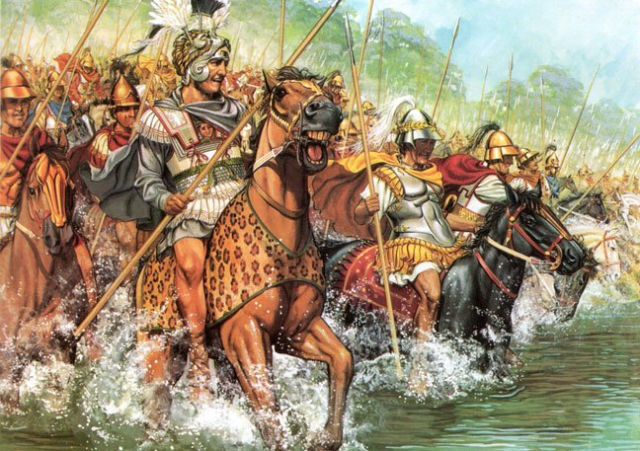
  • Alexander the Great has gone down in history as one of the best generals ever to have lived. After fighting his first battle at just 16 years old in 340BC, Alexander would campaign almost non-stop until his death in 323BC at 32 years old. Throughout this time, he would fight a number of enemies, from Greeks, to Scythians, to Persians, across a variety of battlefields, including open plains, dangerous river crossings and complex sieges. Despite this assortment of enemies and battlefields, as well as often being outnumbered as much as 2:1, he would remain undefeated in his lifetime, solidifying his place as one of the most formidable generals in history.

    The army that Alexander took from Macedonia across the world to India was by far the most powerful army of its time. Its professionalism, flexibility and effectiveness had never before been seen and would not be seen again until almost 400 years later with the Roman legions. Whilst Alexander’s use of this army was by all means incredible, the true genius behind the army’s formation and composition was Alexander’s father, Philip II.

    Philip was a formidable commander in his own right, but his strengths shone more in his military innovations, taking Macedonia from a somewhat weak and backwater kingdom to the strongest power in Greece. This being the case, for us to understand what made Alexander so successful, it is crucial that we understand the army that he inherited from his father, Philip.

    Phalangites

    The backbone of all Hellenistic* armies of the time was the phalanx. This formation was made by hoplites (hop-lights), Greek city-state soldiers with a spear and large shield, forming a wall that was almost unassailable from the front. This formation had served Greek had served Greek armies well for for hundreds of year, being the source of the Greek successes in the Persian Wars. Philip took this tried and tested formation and introduced his own reforms, developing an even more potent force.

    Greek phalanx
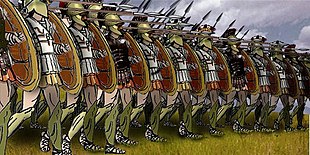
    A Greek hoplite phalanx, note the short spear and large shield.

    Philip spent time as a “hostage” (more like a squire, think Theon of Game of Thrones for the Starks) in Thebes where he would spend time learning from the two great Theban generals, Pelopidas (pel-op-ee-das) and Epaminondas (i-pam-in-on-dis)*. These two men had themselves built Thebes from a second rate power into a force powerful enough to crush the legendary Spartan soldiers in open combat through their military innovations. The most significant change they had made was to have a much deeper phalanx than was usual, thus presenting a narrower front, but with more spear points able to engage the enemy in front. Philip, recognising the power of this, mimicked this with his own phalanx; the standard Greek phalanx seems to have been 8 men deep, whilst Philip’s Macedonian phalanx seems to have been more like 16 men deep.

    Macedonian Phalanx
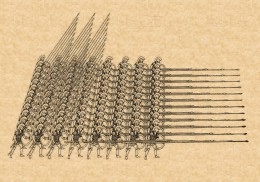
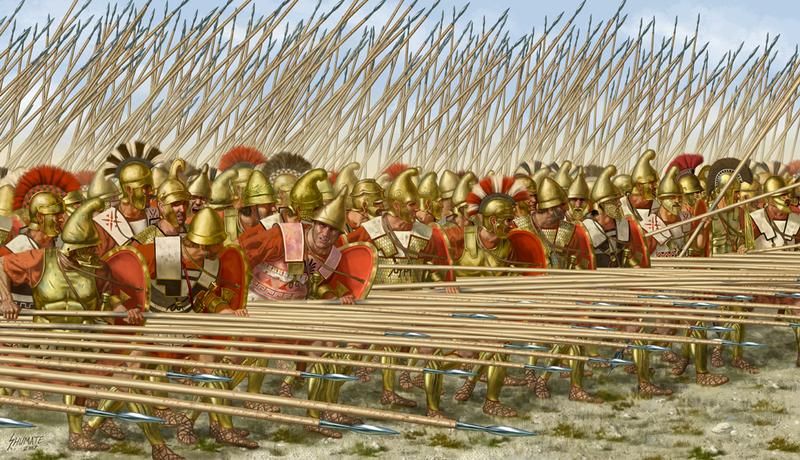
    Macedonian phalangites in phalanx formation, note the longer sarissa pikes and the deep formation

    To maximise on this new formation, Philip also introduced a new way of arming his phalanx, inspired by the innovations of Iphicrates (If-i-crart-ees) of Athens. Iphicrates had introduced a longer spear, along with a smaller shield, to the Athenian hoplites. Philip built on this idea and issued his troops with a 6m long pike, a sarissa (sir-iss-a), also with a smaller shield*. Most other hoplites had used a spear roughly 2-3 metres long, a dory, in one hand, and a large hoplon shield in the other hand (hence the name hoplite). However, the newly armed Macedonian soldiers, known as phalangites (fal-an-jites), wielded their extra-long pike with both hands, while their smaller shield was slung over the forearm of one arm. This crucial innovation, paired with the deeper formation, gave the Macedonian phalanx much more reach than the regular Greek phalanx. It must have been a terrifying prospect for an attacking foe; faced with a wall of spears, he would have had to try battle his way through 6 meters worth of spear points, before even being in striking range of a phalangite. With this in mind, it is easy to see how devastatingly effective these men would have been.

    On top of their better equipment, phalangites were also given much better training than their hoplite counterparts. For the most part, Greek hoplites were citizens called up to fight on behalf of their city-state without too much training. There were some exceptions to this, the Theban Sacred Band and Spartans being notable examples, but on the whole the strength of the Greek phalanx lied in its formation. It was not a hard formation to master, each man simply had to hold his place in the line, shield covering his left side as well as his neighbours right, and thrust with the spear. The effectiveness of this simple formation of citizen soldiers should not be underestimated, Persia had been left licking its wounds multiple times after confronting it. However the lack of training and discipline in the troops can be seen in the fact that Greek phalanxes tended to drift to the right as each man sought to take more cover behind his neighbours shield. These hoplites were not expected to carry out complex drills or changes in formation, but simply to act as a wall.

    hoplite v phalngite
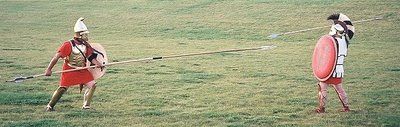
    A Macedonian phalangite (left) compared to a Greek hoplite (right)

    Philip, on the other hand, created a professional army. Unlike the hoplites, the phalangites were not farmers who were called up to service only when needed and required to supply their own equipment; instead they were full time soldiers who were given standardised equipment by the state and given proper training. They were able to perform complex manoeuvres and carry out forced marches giving the Macedonian infantry a level of professionalism almost unheard of in the Greek world. Indeed, in one of Alexander’s confrontations against the Illyrians (the peoples roughly between modern Albania and Croatia), the phalangites drilled before battle, executing complex formation changes and manoeuvres in such a disciplined manner that many Illyrians simply decided to call it a day and fled.

    These phalangites were the backbone on the Macedonian army upon which the rest of the army would be built. In battle they acted as the main line providing a solid platform around which Alexander would construct his tactics. Their professionalism and ability to engage and hold a much larger enemy force would be crucial in Alexander’s campaigns, though the credit for their creation and effectiveness must be given largely to Philip.

    Hypaspists

    While the phalangites were deadly from the front, their phalanx formation relied on it maintaining its structure and so was slow, unwieldy and extremely vulnerable from the flanks and rear. To counter this, Philip introduced an elite heavy infantry unit into the Macedonian army to protect the phalanx, the hypaspists (hip-as-pissts).

    hypaspists
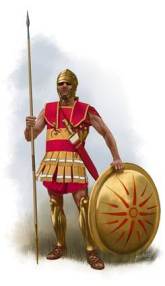
    A hypaspists, note the comparison to the hoplite above with the large shield, and shorter spear than the phalangite.

    Picked from the best of the phalangites, these soldiers were armed more like the traditional Greek hoplite with a larger shield and shorter spear, allowing them more flexibility than the sarissa armed phalangites. Furthermore, as they did not rely on the phalanx formation, they could react more quickly to any outflanking manoeuvres and move rapidly to support the cavalry on the wings if need be. The hypaspists were stationed on the right flank of the phalanx, a traditional place of honour in Hellenic armies. Indeed, Alexander himself would take up position on the right with his Companion cavalry which would be used to strike the main offensive blows. We can see why, therefore, it was important that the hypaspists be more flexible and highly trained. Once the Companions advanced, the phalanx’s right flank would be exposed were it not for the hypaspists. Alternatively, if the Companions needed infantry support, they could rapidly advance to provide assistance.

    As a more elite unit, these troops acted also as the foot bodyguard of Philip and Alexander and were picked for dangerous special missions, such as scaling cliff faces or moving quickly across a river. In Alexander’s campaigns, they played a highly prominent role during sieges where their more flexible armament, greater skill and experience gave them more utility than the phalangites.  It seems that they were almost like the Green Berets of the Macedonian army; elite and highly trained, but in large enough numbers, approximately 3000, to be used as a force individually. The hypaspists were an essential introduction to the Macedonian army by Philip as it helped to negate the phalanx’s key weaknesses; its vulnerable flanks and poor manoeuvrability. Their inclusion in the army was vital as it gave Alexander more tactical options than his phalangites did as well as being able to provide the security Alexander needed to be able to be extremely aggressive with his Companions, which would prove to be crucial in many of his battles.

    Light Infantry

    peltast
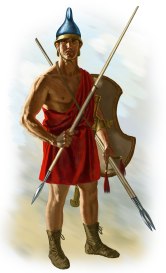
    A peltast, equipped in much the same way as the Thracians and Agrianians

    The light infantry, psiloi (sil-oi) of the Macedonian army has three units of note: the Agrianian (Ag-ree-ain-ian) Peltasts (pelt-asst), the Thracian (Thray-see-un) Peltasts and the Cretan Archers. The Agrianian Peltasts seem to have been an elite unit within the light infantry, also being stationed on the far right, whilst the Thracians fulfilled a similar role, but on the left. Both of these peltasts were skirmishers, wearing little armour and being armed with javelins or slings. The Agrianians seem to have had a more offensive role often being used in conjunction with the hypaspists, providing fast infantry support for the cavalry and harassing any potentially outflanking foes, whilst the Thracians had a similar but more defensive role, protecting the left flank of the phalanx. These two units were also crucial to the army as, alongside the hypaspists, their lighter armour and looser formation meant they could move rapidly in more difficult terrain than the  phalanx could.

    Archers were fairly rare in Greek armies, however, the Cretans had a reputation of being particularly deadly, and so were often hired as mercenaries by Philip and Alexander to provide some range to the army. These archers would likely have been deployed in front of the main force at the start of the battle, before withdrawing behind the main line as needed. Lastly, in the rear of the Macedonian army, were the Greek allied infantry. These would have been traditional Greek hoplites from allied Greek city-states whose role was to protect the rear of the phalanx and the baggage train at the back of the army.

    Summary

    So overall, it should clear to see how crucial Philip’s infantry innovations were in building a formidable and flexible army. Most other Greek armies relied on the phalanx alone being the winning force in the battle. The Macedonian infantry however, was a true example of combined arms tactics, each part complimenting the other: as the phalangites pikes could pin down and engage the enemy infantry, they could do so safe in the knowledge that the peltasts and hypaspists would guard their flanks; if the cavalry advanced on the right flank, the hypaspists could either rush to support them, or remain to guard the flank in their place; where the terrain proved to difficult for the phalanx, the hypaspists and light infantry could be used instead. It was a truly devastating force, effective in both open battlefields and in sieges.

    Whilst it would be silly to not recognise Alexander’s excellent use of this infantry, it is important to remember that the mastermind behind their creation was Philip and so he must also be credited with their success. In this powerful infantry body, Philip had provided Alexander with an anvil. However, Macedonia’s true power lied in its devastating hammer; the cavalry.


    *A general term for all Greek nations/city-states, comparable to words like Nordic or Germanic.

    *The ‘I’ here should sound like the ‘I’ in ‘it’ rather than rhyming with eye.

    *Same as above, once you get your ear in, pronouncing the names is not as hard as it initially seems!

    *They were also issued a sword, however, this was much more of a backup weapon and, so long as the phalanx remained intact, would rarely be used.