The Macedonian cavalry is perhaps the most famous aspect of Alexander’s army. They were a force unlike anything seen before and were Alexander’s most valuable battlefield asset. Once again though, despite Alexander being a masterful tactician, the creation of much of the Macedonian cavalry was thanks largely to Philip.
It is hard to say how Macedonian cavalry functioned before Philip’s reign, however, what is obvious is that it underwent serious reformation under Philip, just as the infantry had. His innovations would develop the Macedonian Cavalry from an effective force, into the very best in the ancient world. Thanks to Philips innovations and Alexander’s tactics they would become the deciding force in many of Alexander’s battles. This is an important note to understand; Philip and Alexander seem to be the first two Hellenistic generals who used heavy cavalry as a dedicated battlefield force alongside the infantry. They were not being used as a mere supplement to the infantry, but as an integral part of the army, making up almost a sixth of Alexander’s army. It was a revolutionary idea, and one of the very first examples of true combined arms tactics that would be mimicked for centuries to come.
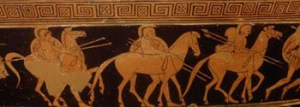
Comparatively, cavalry in the Greek city-states, or poleis (pol-ey-us), played second fiddle to the hoplite phalanx. They were mostly lightly armoured horsemen and used javelins, mainly acting as scouts or as a screening force. There were a few exceptions to this in city-states, such as the hippes, who were more akin to medieval knights, i.e. wealthy citizens wearing heavier armour, however, even these were used in such low numbers that they should not be counted as a definitive battlefield force. A notable example would be the Spartans who would not create a dedicated cavalry force until 404BC, just 50 years before Alexander’s birth! However, just as the Greek city-states, had gained renown for their hoplite heavy infantry, their neighbouring kingdoms, Macedonia and Thessaly, were famous for their horsemen, often being hired by the city-states as mercenaries, showing how highly regarded they were.
Companions
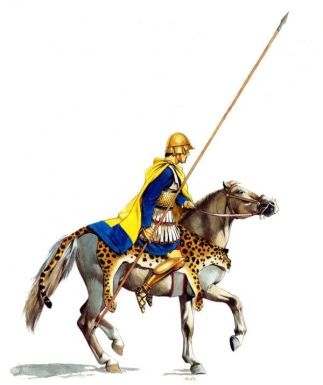
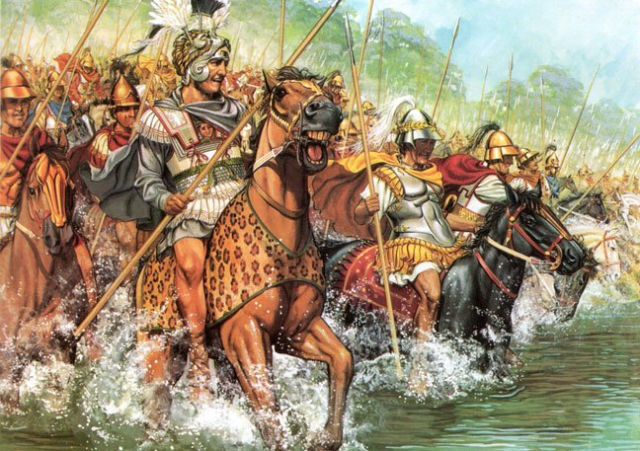
The most famous of the Macedonian Cavalry was of course, the Companions or hetairoi (het-eye-roy). These soldiers were heavily armoured and armed with a double tipped 3-4 meter long spear, called a xyston. This seems to have been introduced by Philip himself and developed the Companions into the first true shock cavalry force in history. These soldiers were not used simply to harass enemies or pursue fleeing foes as cavalry had previously been used, but as an iron first capable of devastating mass cavalry charges, something unheard of beforehand. To make this force even more potent, Philip also adapted the wedge formation from the Thessalians. This allowed for quicker manoeuvrability, as the leader was always out in front and so easily followed, whilst its shape made it ideal for punching through and enlarging gaps in the opposing formations. As a chisel could be hammered into a crack, so could the Companions smash the weak point in an enemy line. A true crack cavalry unit. (sorry)
The Companions held the position of honour on the right flank of Macedonian armies and would also act as the mounted Royal Bodyguard. During Alexander’s campaigns, they were often led by Alexander himself, and contained many of Alexander’s closest and most gifted friends and lieutenants. Due to their heavy armour and excellent training, in sieges they could dismount and fight as heavy infantry, proving to be as deadly on foot as on horseback. Thanks to Philip’s reformations, they became the true powerhouse of the Macedonian army, and many of Alexanders victories can be attributed to a devastating charge of Companions at the crucial moment in the battle.
Thessalian Cavalry
While the Companions took place of honour on the right flank and acted as the aggressive arm of the army, the left flank was held and defended by the previously mentioned Thessalian Cavalry. Philip had held the position of Archon of the Thessalian League, effectively the head of all Thessalian peoples, and so was easily able to assimilate these famous horsemen into his army.
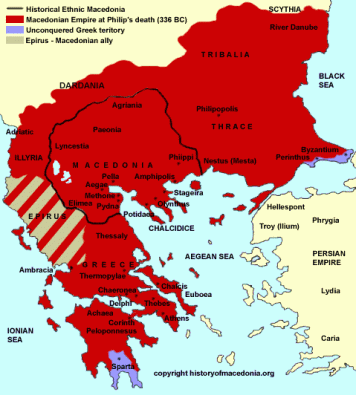
Positioned on the left, their role was less offensive than the Companions but no less crucial. Armed in a similar style to the Companions, their task was to protect the flank of the phalanx and prevent encirclement; a difficult role and one that speaks to their high regard and trust. They would fight extremely tough battles in Alexander’s campaigns, both at Issus and Gaugamela notably, where they were often outnumbered and where their failure could have resulted in the encircling of the whole army and so disaster. The reliability of this force allowed Alexander to focus on the right flank where he could strike the definitive blow with his Companions, safe in the knowledge that the Thessalians would hold the other flank.
Prodromoi
The Macedonian cavalry was rounded off by the light cavalry, the prodromoi (prod-rom-oi). These soldiers were armed much more like the majority of Greek cavalry mentioned above with light armour and javelins. They fulfilled the more traditional cavalry roles, scouting and screening.Though not as glamorous nor prestigious a role as the Companions and Thessalians, their role was nonetheless important in scouting and gathering important information prior to a battle, something Alexander put a lot of emphasis on. However, as Alexander’s campaign continued, he would incorporate native light cavalry into his army such as eastern horse archers, and these natives proved to be better at scouting. It seems that Alexander then armed the prodromoi with a sarissa and that they too adopted more of a shock cavalry role.
Summary
The use of heavy cavalry as a shock force was revolutionary and is the source of much of the armies success. Alexander would personally oversee the Companions in almost all their battles, a testament to how valuable they were, leading charges at the weak points in the enemy line and turning the battle. Philip had completely reinvented how battles would now be fought, particularly in the Hellenistic world. No longer were battles decided by shoving matches between massed infantry bodies, but by the careful timing and execution of a cavalry charge into the back of the engaged foes; the classic hammer and anvil. This was a tactic which Alexander mastered and would become a staple of a generals recipe book, from Hannibal to Napoleon to everyone playing Total War.
Overall, what we see at the end of Philip’s reign is a truly devastating army. Philip had learned from neighbouring states, adopting and adapting tactics as he saw fit to develop a professional, well drilled and balanced army. The combination of heavy infantry, skirmishers and heavy cavalry gave the Macedonian army a level of flexibility previously unheard of. Philip had taken a nation that was considered a bystander to the major Greek players, and formed a force powerful enough to go toe to toe against the very best that the Greeks and Persians had to offer. Upon his death, Alexander would inherit the most professional and deadly army in the ancient world. Thanks to his father, Alexander would not have to waste anytime building his own army, but could use his Philip’s force as soon as he took the throne to begin his conquest of the known world. Whilst it might seem, therefore, that the majority of Alexander’s success be attributed to Philip, it is important that we understand that any army is only ever as strong as it’s general. As Alexander himself said:
“It is better to have sheep led by a lion than lions by a sheep”
 Historiai